

What Night Vision Camera Does Ghost Adventures Use
Ghost hunting is the process of investigating locations that are reported to be haunted by ghosts. Typically, a ghost-hunting squad will attempt to collect evidence supporting the existence of paranormal activity. Ghost hunters use a variety of electronic devices, including EMF meters, digital thermometers, both handheld and static digital video cameras, including thermographic and night vision cameras, night vision goggles, as well every bit digital audio recorders. Other more traditional techniques are as well used, such as conducting interviews and researching the history of allegedly haunted sites. Ghost hunters may also refer to themselves as "paranormal investigators."[ane]
Ghost hunting has been heavily criticized for its dismissal of the scientific method. No scientific written report has always been able to ostend the existence of ghosts.[2] [3] The practice is considered a pseudoscience by the vast majority of educators, academics, science writers, and skeptics.[4] [5] [6] [7] [eight] [ix] [10] [xi] Science historian Brian Regal described ghost hunting as "an unorganized exercise in futility".[4]
History [edit]
Paranormal research dates dorsum to the 18th century, with organisations such as the Order for Psychical Research investigating spiritual matters. Psychic researcher Harry Cost published his Confessions of a Ghost-Hunter in 1936.[12]
Ghost hunting was popularised in the 2000s by television serial such as Most Haunted and Ghost Hunters, combined with the increasing availability of high-tech equipment. The Atlantic Paranormal Gild reported a doubling in their membership in the late 2000s, attributing this to the television programs. Despite its lack of acceptance in academic circles, the popularity of ghost-hunting reality TV shows has influenced a number of individuals to take upward the pursuit.[13]
Small-scale businesses offering ghost-hunting equipment and paranormal investigation services increased in the early 2000s. Many offer electromagnetic field (EMF) meters, infrared motion sensors and devices billed as "ghost detectors". The paranormal boom is such that some small ghost-hunting related businesses are enjoying increased profits through podcast and spider web site advertising, books, DVDs, videos and other commercial enterprises.[xiv]
I ghost-hunting group called "A Midwest Haunting" based in Macomb, Illinois, reported that the number of people taking its tours had tripled, jumping from about 600 in 2006 to 1,800 in 2008. Others, such equally Marie Cuff of "Idaho Spirit Seekers" pointed to increased traffic on their websites and bulletin boards as an indication that ghost hunting was condign more accepted. Participants say that ghost hunting allows them to enjoy the friendship of agreeing people and actively pursue their interest in the paranormal. According to Jim Willis of "Ghosts of Ohio", his group's membership had doubled, growing to xxx members since it was founded in 1999 and includes both true believers and total skeptics. Willis says his grouping is "looking for answers, one way or another" and that skepticism is a prerequisite for those who desire to be "taken seriously in this field."[thirteen]
Author John Potts says that the present solar day pursuit of "amateur ghost hunting" can exist traced back to the Spiritualist era and early organizations founded to investigate paranormal phenomena, like London's The Ghost Club and the Guild for Psychical Enquiry, but that mod investigations are unrelated to academic parapsychology. Potts writes that modern ghost hunting groups ignore the scientific method and instead follow a class of "techno-mysticism".[11]
The popularity of ghost hunting has led to some injuries. Unaware that a "spooky home" in Worthington, Ohio was occupied, a grouping of teenagers stepped on the edge of the property to explore. The homeowner fired on the teenagers' automobile every bit they were leaving, seriously injuring one.[15] A woman hunting for ghosts was killed in a fall from a University of Toronto building.[16]
An offshoot of ghost hunting is the commercial ghost tour conducted by a local guide or tour operator who is often a member of a local ghost-hunting or paranormal investigation group. Since both the bout operators and owners of the reportedly haunted backdrop share profits of such enterprises (admissions typically range between $50 and $100 per person), some believe the claims of hauntings are exaggerated or fabricated in social club to increase omnipresence.[17] The city of Savannah, Georgia is said to be the American city with the about ghost tours, having more than than 31 equally of 2003.[18] [19]
Notable paranormal investigators [edit]
Harry Price [edit]
Harry Price (17 January 1881 – 29 March 1948) was a British parapsychologist, psychic researcher and author who gained public prominence for his investigations into psychical phenomena and his exposing of fraudulent spiritualist mediums. He is best known for his well-publicized investigation of the purportedly haunted Borley Rectory in Essex, England. Price's exploits were given wide exposure in a 1950 book, Harry Price, Biography of a Ghost Hunter by Paul Tabori. He was also a longstanding member of the Ghost Guild based in London.
Cost joined the Lodge for Psychical Research (SPR) in 1920, and used his noesis of stage magic to debunk fraudulent mediums.[xx] In 1922, he exposed the 'spirit' photographer William Hope.[21] [22] In the same yr he travelled to Germany together with Eric Dingwall and investigated Willi Schneider at the home of Businesswoman Albert von Schrenck-Notzing in Munich.[23] In 1923, Cost exposed the medium Jan Guzyk. According to Price the "man was clever, especially with his anxiety, which were most as useful to him every bit his easily in producing phenomena."[24]
Price wrote that the photographs depicting the ectoplasm of the medium Eva Carrière taken with Schrenck-Notzing looked artificial and two-dimensional fabricated from cardboard and newspaper portraits and that in that location were no scientific controls as both her hands were free. In 1920 Carrière was investigated by psychical researchers in London. An analysis of her ectoplasm revealed it to be fabricated of chewed paper. She was also investigated in 1922 and the result of the tests were negative.[25] In 1925, Price investigated Maria Silbert and caught her using her feet and toes to move objects in the séance room.[26] He also investigated the "direct voice" mediumship of George Valiantine in London. In the séance Valiantine claimed to take contacted the "spirit" of the composer Luigi Arditi , speaking in Italian. Price wrote downwards every word that was attributed to Arditi and they were found to exist word-for-word matches in an Italian phrase-volume.[27]
In 1926, Toll formed the National Laboratory of Psychical Enquiry equally a rival to the Society for Psychical Research.[28] Price made a formal offering to the University of London to equip and endow a Section of Psychical Enquiry, and to loan the equipment of the National Laboratory and its library. The University of London Board of Studies in Psychology responded positively to this proposal.
Cost had a number of public disputes with the SPR, most notably regarding professed medium Rudi Schneider.[29] [30] Price exposed Frederick Tansley Munnings, who claimed to produce the independent "spirit" voices of Julius Caesar, Dan Leno, Hawley Harvey Crippen and King Henry Eight. Price also invented and used a piece of apparatus known as a "voice command recorder" and proved that all the voices were those of Munnings. In 1928, Munnings admitted fraud and sold his confessions to a Sunday paper.[31]
In 1933, Frank Decker was investigated past Cost at the National Laboratory of Psychical Research.[32] Under strict scientific controls that Price contrived, Decker failed to produce whatever phenomena at all.[33] Toll's psychical research continued with investigations into Karachi'southward Indian rope trick and the burn down-walking abilities of Kuda Bux In 1936, Cost broadcast from a supposedly haunted estate house in Meopham, Kent for the BBC and published The Confessions of a Ghost-Hunter and The Haunting of Cashen's Gap. This yr also saw the transfer of Toll's library on permanent loan to the University of London (see external links below), followed shortly by the laboratory and investigative equipment. In 1937, he conducted further televised experiments into fire-walking with Ahmed Hussain at Carshalton and Alexandra Palace, and also rented Borley Rectory for ane year. The following year, Price re-established the Ghost Club, with himself equally chairman, modernizing it and changing it from a spiritualist clan to a grouping of more or less open-minded skeptics that gathered to hash out paranormal topics. He was also the get-go to admit women to the club. Price drafted a Nib for the regulation of psychic practitioners, and in 1939, he organised a national telepathic exam in the periodical John O'London's Weekly. During the 1940s, Price concentrated on writing and the works The About Haunted Business firm in England, Poltergeist Over England and The Cease of Borley Rectory were all published.
Price'south friends included other debunkers of fraudulent mediums such every bit Harry Houdini and the journalist Ernest Palmer.[34] [35]
Ed and Lorraine Warren [edit]
Edward Warren Miney (September 17, 1926 – August 23, 2006) and Lorraine Rita Warren (née Moran, January 31, 1927 – April 18, 2019) were American paranormal investigators and authors associated with prominent reports of haunting from the 1950s to the present. Edward was a World State of war 2 United States Navy veteran and old constabulary officer who became a self-taught and self-professed demonologist, author, and lecturer. Lorraine professes to be clairvoyant and a light trance medium who worked closely with her husband. In 1952, the Warrens founded the New England Society for Psychic Research, the oldest ghost hunting group in New England. They authored numerous books about the paranormal and about their private investigations into diverse reports of paranormal activity. They claimed to have investigated over 10,000 cases during their career, and have been involved with various supernatural claims such as the Snedeker family haunting, the Enfield Poltergeist and the Smurl haunting, equally well every bit claims of demonic possession in the Trial of Arne Cheyenne Johnson.
The Warrens are best known for their involvement in the 1976 Amityville Horror case in which New York couple George and Kathy Lutz claimed that their house was haunted by a violent, demonic presence so intense that it eventually drove them out of their habitation. The Amityville Horror Conspiracy authors Stephen and Roxanne Kaplan characterized the case equally a "hoax".[36] Lorraine Warren told a reporter for The Express-Times paper that the Amityville Horror was not a hoax. The reported haunting was the footing for the 1977 book The Amityville Horror, which was adjusted into the 1979 and 2005 movies of the same proper name, while also serving as inspiration for the picture show series that followed. The Warrens' version of events is partially adapted and portrayed in the opening sequence of The Conjuring 2 (2016). According to Benjamin Radford, the story was "refuted by eyewitnesses, investigations and forensic prove".[37] In 1979, lawyer William Weber reportedly stated that he, Jay Anson, and the occupants "invented" the horror story "over many bottles of wine".[38]
General criticism of the Warrens include those by skeptics Perry DeAngelis and Steven Novella, who investigated the Warrens' evidence and described it as "blarney".[39] Skeptical investigators Joe Nickell and Ben Radford too concluded that the more famous hauntings such every bit Amityville and the Snedeker family haunting, did not happen and had been invented.[37]
Stories of ghosts and hauntings popularized by the Warrens accept been adapted as or accept indirectly inspired dozens of films, television series and documentaries, including 17 films in the Amityville Horror series and half dozen films in The Conjuring Universe including Annabelle, Annabelle: Creation, and Annabelle Comes Domicile, spin-off prequels of The Conjuring.
Belief statistics [edit]
According to a survey conducted in October 2008 by the Associated Press and Ipsos, 34 percent of Americans say they believe in the beingness of ghosts.[xiii] Moreover, a Gallup poll conducted on June 6–viii, 2005 showed that i-third (32%) of Americans believe that ghosts be, with belief declining with age.[40] [41] Having surveyed three countries (the Us, Canada, and Cracking Britain), the poll likewise mentioned that more than people believe in haunted houses than whatsoever of the other paranormal items tested, with 37% of Americans, 28% of Canadians, and 40% of Britons believing.[41] [42]
In 2002, the National Science Foundation identified haunted houses, ghosts, and communication with the dead among pseudoscientific beliefs.[5]
Skepticism [edit]
Critics question ghost hunting's methodology, particularly its use of instrumentation, as there is no scientifically proven link between the beingness of ghosts and common cold spots or electromagnetic fields. According to skeptical investigator Joe Nickell, the typical ghost hunter is practicing pseudoscience.[43] Nickell says that ghost hunters oftentimes arm themselves with EMF meters, thermometers that can identify cold spots, and wireless microphones that eliminate background noise, pointing out the equipment being used to try to detect ghosts is not designed for the chore. "The least probable explanation for whatever given reading is it is a ghost," maintains Nickell. Orbs of light that prove up on photos, he says, are often particles of dust or moisture. "Voices" picked upwards by tape recorders can be radio signals or noise from the recorder, EMF detectors can be fix off by faulty wiring, microwave towers,[13] fe, recording equipment, or cell phones, and heat sensors tin pick up reflections off of mirrors or other metal surfaces. Nickell has likewise criticized the do of searching only in the night, saying that since some ghosts are described as "shadows or dark entities," he conducts searches in lighted rather than darkened conditions.[44] Radford agrees, If the purpose of the investigation is to become chilling footage, plow the lights off. If the purpose is to scientifically search for show of ghosts, leave the lights on".[45]
According to investigator Benjamin Radford, near ghost-hunting groups including The Atlantic Paranormal Society make many methodological mistakes. "After watching episodes of Ghost Hunters and other similar programs, information technology quickly becomes clear to anyone with a background in science that the methods used are both casuistic and unscientific". Anyone can be a ghost investigator, "failing to consider alternative explanations for dissonant ... phenomena", considering emotions and feelings as "evidence of ghostly encounters". "Improper and unscientific investigation methods" for instance "using unproven tools and equipment", "sampling errors", "ineffectively using recording devices" and "focusing on the history of the location...and not the phenomena". In his article for Skeptical Inquirer Radford concludes that ghost hunters should care about doing a truly scientific investigation "I believe that if ghosts exist, they are important and deserve to exist taken seriously. Almost of the efforts to investigate ghosts so far have been desperately flawed and unscientific – and, non surprisingly, fruitless."[8]
Although some ghost hunters believe orbs are of supernatural origin, skeptic Brian Dunning says that they are usually particles of grit that are reflected by light when a picture is taken, sometimes it may be bugs or water droplets. He contends that "there are no plausible hypotheses that describe the mechanism by which a person who dies will get a hovering ball of calorie-free that appears on film but is invisible to the center." He does not believe there is any scientific discipline behind these beliefs; if there were then there would be some kind of give-and-take of who, what and why this can happen. In his investigations he tin can not notice any "plausible hypothesis" that orbs are anything paranormal.[46]
Science writer Sharon Hill reviewed over 1,000 "amateur research and investigation groups" (ARIGs), writing that "879 identified with the category of "ghosts". Hill reports that many groups used the terms "scientific discipline" or "scientific" when describing themselves; even so "they overwhelmingly display neither understanding of nor adherence to scientific norms".
"ARIGs often promote their paranormalist viewpoint every bit scientifically based, especially in community presentations or lectures at educational facilities. While scientifically minded observers can readily spot the anemic and shoddy scholarship of popular paranormal investigation, the public, unaware of the fundamental errors ARIGs make, can exist persuaded by jargon and "sciencey" symbols."
Hill sees the supernatural bias of such groups every bit an indication of how "far removed ARIG participants actually are from the established scientific community".[7]
In Hill'due south 2017 book Scientifical Americans reviewed by historian Brian Regal for Skeptical Inquirer magazine, Regal writes, that this is a timely volume as it comes during an era when many question science. Regal wonders why believers think that "untutored amateurs know more (and are more than trustworthy) than professional scholars". He asks why at that place is trivial word on "philosophical and theological aspects of their work". For instance, the theoretical questions such equally, "what is a ghost?" and "does one's religion in life determine if they can become a ghost in death?" Loma gives a historiography of the field of "modern paranormal involvement: monsters, UFOs, and ghosts." She does not insult or ridicule the people she writes nearly, simply explains their stories through case studies. Royal feels that this book will not deter believers in the paranormal, but it is an of import part of a "growing literature on amateur paranormal research". Purple states that paranormal researchers are not engaging in scientific discovery but are engaging "blithely in confirmation bias, selective evidence compiling, and the backfire effect while all the fourth dimension complaining that it is the other side doing it. ... They, like all of united states of america, are ultimately not searching for ghosts ... they are looking for themselves."[47]
In May 2018, Kenny Biddle, a skeptical investigator of paranormal claims, spent a night in the White Loma Mansion in Fieldsboro, New Jersey along with a grouping of fellow skeptics. The mansion, congenital in 1757, has traditionally been visited by many ghost hunting teams who claim to accept experienced paranormal activity and communicate with spirits via EVPs while in that location. According to Biddle, many of the ghost hunters claimed that the EVPs they obtained "were not only random responses; they were directly, intelligent responses to specific questions". To challenge these claims, Biddle'southward group conducted a controlled experiment: the group recorded sound while asking whatever spirits in the Mansion to help them in locating a small foam toy hidden somewhere on the premises by a 3rd party. They asked direct questions, only no responses were detected during review of the audio. Biddle subsequently reset the experiment and has offered a prize to ghost hunters for proof of their claim that they tin can obtain direct answers from spirits via EVP. [48]
Methods and equipment [edit]
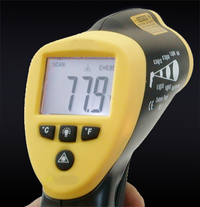
A handheld infrared thermometer of the type used by some ghost hunters
Ghost hunters apply a diverseness of techniques and tools to investigate alleged paranormal activity.[49] [50] While there is no universal credence among ghost hunters of the following methodologies, a number of these are unremarkably used by ghost hunting groups.[51]
- Still photography and video: using digital, night vision, infrared, and even dispensable cameras.
- EMF meter: to detect possibly unexplained fluctuations in electromagnetic fields.
- Tablet PC: to record data, audio, video and even environmental fluctuations such as electromagnetic fields.[51]
- Ambient temperature measurement: using thermographic cameras, thermal imaging cameras, infrared thermometers, and other infrared temperature sensors. All of these methods simply measure surface temperature and not ambience temperature.[52]
- Digital and analog audio recording: to capture whatever unexplained noises and electronic voice phenomena (EVPs), that may be interpreted as disembodied voices.
- Compass: some ghost hunters use a compass to determine the location of paranormal spots, similar to EMFs.
- Geiger counter: to measure fluctuations in radiation.
- Infrared and/or ultrasonic motion sensors: to detect possible anomalous movement within a given area, or to assist in creating a controlled surroundings where any human being movement is detected.
- Air quality monitoring equipment: to appraise the levels of gases such equally carbon monoxide, which are thought to contribute to reports of paranormal action.
- Infrasound monitoring equipment: to appraise the level of sound vibrations.
- Dowsing rods: commonly constructed of contumely and bent into an L-shape.
- Psychics, mediums, or clairvoyants: trance mediums or "sensitive" individuals thought to take the ability to identify and make contact with spiritual entities.
- Demonologists, exorcists, and clergy: individuals who may say prayers, give blessings, or perform rituals for the purpose of cleansing a location of declared ghosts, demons, poltergeists, or "negative energy".
- Lights out: co-ordinate to ghost hunting enthusiast websites, many ghost hunters prefer to comport their investigations during "peak" evening hours (midnight to iv a.1000.).
- Ghost Box: a radio with a frequency browse mode that some ghost hunters claim allows advice with spirits.
- Interviews: collecting testimony and accounts about declared hauntings.
- Historical inquiry: researching the history behind the site being investigated.
- A Ouija board to communicate with spirits.
- Dark vision and full spectrum video and photography are used by ghost hunters to visualize areas of the calorie-free spectrum unseen by the human eye including infrared (IR) and ultraviolet (UV).
- Trigger objects are props or tools that ghost hunters claim can be used to attract an entity to interact. According to ghost hunters, this could exist whatever object which might bring emotion or connection such as a teddy bear, photo or a wedding band, and some pieces of equipment have been designed within a trigger object in order to help notice a presence around the object.
- Thermographic cameras, according to ghost hunters, are helpful in detecting and visualizing temperature changes during an investigation. According to ghost hunters, they are known, in brusk, as a 'thermal'.
- According to a psychic medium, "dogs growling and barking at certain places on a property" and cats gravitating or looking into a detail area every bit if someone were present are believed to signal a haunting.[53]
- SLS or Kinect camera. A device that uses a pattern of Infrared dots to detect objects in consummate darkness.[54] Analyzed by Kenny Biddle[55](video)[56] and found prone to spurious results when used as a not-stationary device.
Cold spots [edit]
According to ghost hunters, a common cold spot is an area of localized coldness or a sudden decrease in ambience temperature. Many ghost hunters use digital thermometers or heat sensing devices to measure such temperature changes. Believers claim that cold spots are an indicator of paranormal or spirit activeness in the area; still, there are many natural explanations for rapid temperature variations inside structures, and there is no scientifically confirmed testify that spirit entities exist or can touch air temperatures.[57]
"Orbs" [edit]
Some ghost hunters claim that circular artifacts appearing in photographs are spirits of the expressionless or other paranormal phenomena;[58] [59] [threescore] however, such visual artifacts are a result of flash photography illuminating a mote of dust or other particle, and are particularly mutual with modern compact and ultra-compact digital cameras.[61] [62] [63] [64]
Depiction in media [edit]
Television receiver [edit]
Ghost Hunters [edit]
Ghost Hunters features the activities of a Warwick, Rhode Isle ghost hunting group called The Atlantic Paranormal Society (TAPS). Since 2004, the program has garnered some of the highest ratings of any Syfy network programming, presenting a mix of paranormal investigation and interpersonal drama. It has since been syndicated on NBCUniversal sister cable channel Oxygen and also airs on the Canadian cable network, OLN. In addition to their television set venture, TAPS hosts a three-hour weekly radio show called Beyond Reality, operates a website where they share their stories, photographs, and ghost hunting videos with members. TAPS cast members also appear at lectures, conferences and public events.
Ghost Adventures [edit]
Ghost Adventures premiered in 2008 on the Travel Aqueduct. The TV series features ghost hunters Zak Bagans, Nick Groff (seasons 1–10), Aaron Goodwin, Billy Tolley, and Jay Wasley equally they investigate reportedly haunted locations hoping to collect visual or auditory testify of paranormal activity.
The Haunted Collector [edit]
Haunted Collector features a team of paranormal investigators led past demonologist John Zaffis who investigate allegedly haunted locations in hopes of identifying, and removing objects they believe can trigger supernatural activity. The objects are transported for eventual display in Zaffis's museum. The series premiered in 2011 on the Syfy cablevision television channel, and was cancelled in 2013.
Films [edit]
Poltergeist [edit]
Poltergeist is the original moving-picture show in the Poltergeist trilogy, directed by Tobe Hooper, co-written by Steven Spielberg and released on June iv, 1982. The story focuses on the Freeling family, which consists of Steven (Craig T. Nelson); Diane (JoBeth Williams); Dana (Dominique Dunne); Robbie (Oliver Robins); and Carol Anne (Heather O'Rourke), who live in a California housing development called Cuesta Verde, which comes to be haunted by ghosts. The film depicts a group of paranormal investigators, parapsychologists, and a spiritual medium named Tangina Barrons (Zelda Rubinstein) in their efforts to assist the family. A reboot of the series, Poltergeist, was directed by Gil Kenan and released on May 22, 2015 that features the host of a paranormal-themed Television show who comes to the assistance of the family.
Ghostbusters [edit]
Ghostbusters is a 1984 American fantasy one-act picture produced and directed by Ivan Reitman and written by Dan Aykroyd and Harold Ramis. It stars Beak Murray, Aykroyd and Ramis as Peter Venkman, Ray Stantz and Egon Spengler, eccentric parapsychologists who commencement a ghost-catching concern in New York City. Ghostbusters was released in the United States on June 8, 1984 and grossed $242 million in the United States and more than than $295 meg worldwide, making information technology the highest-grossing comedy film of its time. It launched a media franchise, which includes two sequels (Ghostbusters II and Ghostbusters: Afterlife), two animated tv serial (The Real Ghostbusters and Extreme Ghostbusters), video games, and a 2016 reboot. The Ghostbusters concept was inspired by Aykroyd's fascination with the paranormal.
The Conjuring [edit]
The Conjuring is a 2013 American supernatural horror film directed by James Wan and written by Chad Hayes and Carey W. Hayes. It is the inaugural picture show in The Conjuring Universe franchise, in which Patrick Wilson and Vera Farmiga star every bit paranormal investigators Ed and Lorraine Warren. Their purportedly real-life exploits inspired The Amityville Horror story and motion picture franchise. In The Conjuring, the Warrens come to the aid of the Perron family, who experience increasingly disturbing events in their farmhouse in Rhode Island in 1971. The Conjuring was released in the United States and Canada on July 19, 2013, and grossed over $319 million worldwide. A sequel, The Conjuring 2, was released on June x, 2016, and a prequel, Annabelle, directed past John R. Leonetti, written past Gary Dauberman and produced by Peter Safran and James Wan was released in 2014.
Video games [edit]
Phasmophobia [edit]
Kinetic Games' indie survival horror game sees the player(s) accept on the role of ghost hunters contracted to explore various bounds for ghosts. The game received a large influx of popularity after its September 2020 release due to many well-known Twitch streamers and YouTubers playing it, mainly for the Halloween season.[65]
Web serial [edit]
Buzzfeed Unsolved [edit]
The American amusement web serial BuzzFeed Unsolved includes BuzzFeed Unsolved Supernatural episodes where hosts Madej and Bergara discuss alleged ghosts, hauntings and demons, frequently seeking evidence of their existence.[66]
Further reading [edit]
- Robert Lea (31 Oct 2021). "Ghost Hunters Who Utilize Science Reveal What Other Paranormal Investigators Get Wrong". Newsweek.
External links [edit]
- "Ghost Hunting in the 19th Century" (Audio with transcript). Science History Found 'Distillations' Podcast Episode 277. 6 Jul 2021.
- Ghost hunting at Curlie
- Dunning, Brian (January 1, 2008). "Skeptoid #81: Ghost Hunting Tools of the Trade". Skeptoid.
- "Ghost Hunting Scientific discipline Vs Pseudoscience" past Steven Novella
- "Proton Packs and Teddy Bears: The Pseudoscientific History of Ghost Hunting Gadgets" by Popular Mechanics
See also [edit]
- Legend tripping
- List of ghost films
- Listing of topics characterized equally pseudoscience
- Paranormal television receiver
- Stone Tape
References [edit]
- ^ Cohen, Howard (September xix, 2009). "Ghost hunters say Deering Manor is ground cipher for lost spirits". The Miami Herald. Archived from the original on October 10, 2010. Retrieved 8 January 2010.
- ^ Radford, Benjamin (27 October 2006). "The Shady Science of Ghost Hunting". LiveScience. Retrieved 15 December 2009.
- ^ "Study: No Scientific Basis for Vampires, Ghosts". Associated Printing. 2015-03-25. Retrieved 2020-02-25 .
- ^ a b Regal, Brian. (2009). Pseudoscience: A Disquisitional Encyclopedia. Greenwood. pp. 43; 75–77. ISBN 978-0-313-35507-iii
- ^ a b "Relationships Betwixt Scientific discipline and Pseudoscience". Science and Technology Indicators, 2002. National Scientific discipline Foundation. Archived from the original on sixteen June 2016. Retrieved 12 September 2015.
- ^ Dr Olu Jenzen; Professor Sally R Munt (28 January 2014). The Ashgate Research Companion to Paranormal Cultures. Ashgate Publishing, Ltd. pp. 197–. ISBN978-1-4724-0612-5.
- ^ a b Loma, Sharon. "Amateur Paranormal Research and Investigation Groups Doing 'Sciencey' Things". Csicop.org. Skeptical Inquirer – Book 36.2 March/April 2012. Retrieved 26 February 2015.
- ^ a b Radford, Benjamin. "Ghost-hunting mistakes: scientific discipline and pseudoscience in ghost investigations". Skeptical Inquirer. Committee for Skeptical Enquiry. Archived from the original on 4 Oct 2015. Retrieved 12 September 2015.
- ^ Schmaltz, Rodney (25 Apr 2014). "Battling Psychics and Ghosts: The Demand for Scientific Skepticism". Huffington Postal service . Retrieved 12 September 2015.
- ^ Campbell, Hank (27 August 2014). "Think Pseudoscience Isn't Dangerous? Ghost Hunter Looking For Ghost Train Killed Past Real One". Science 2.0. ION Publications. Retrieved 12 September 2015.
- ^ a b Potts, John; James Houran (2004). Ghost Hunting In The 20-First Century (From Shaman to scientist: essays on humanity'due south search for spirits). Scarecrow Printing. ISBN9780810850545 . Retrieved fifteen Dec 2009.
- ^ Price, Harry (1936). Confessions of a ghost-hunter. Putnam.
- ^ a b c d Peterson, Skip; Associated Press (2008-05-31). "Ghost-hunting groups savour surge in popularity". United states Today. Retrieved fourteen December 2009.
- ^ Scaring Upward Paranormal Profits
- ^ Smyth, Julie C (2007-08-21). "'Spooky Business firm' case splits Ohio suburb". USA Today . Retrieved 2008-08-24 .
- ^ "Ghost-hunting woman dies at U of Toronto". United Press International. September 10, 2009. Retrieved 15 December 2009.
- ^ Howard, Philip (Dec xviii, 2006). "Confessions of a Ghost Tour Guide and Skeptic". The Committee for Skeptical Inquiry. Retrieved 15 Dec 2009.
- ^ "Walk your scaredy-pants off in Savannah". CNN.com Travel. CNN. 2003-ten-30. Retrieved 2010-05-03 .
- ^ "Rantoul grad's moving-picture show explores 'America'south Most Haunted City'". News-Gazette.
- ^ Paul Tabori. (1974). Harry Toll: The Biography of a Ghosthunter. Sphere Books. pp. 43-48. ISBN 0-7221-8326-7
- ^ Leaves from a Psychist's Instance Book by Harry Price, Page 213.
- ^ Hall (1978) p. 222
- ^ Hall (1978) pp. 136–153
- ^ Harry Price. (1942). Search for truth: My Life for Psychical Research. Collins p. 206
- ^ Harry Price. (1939). Fifty Years of Psychical Inquiry. Longmans, Dark-green & Co. ISBN 978-0-7661-4242-8
- ^ Lewis Spence. (1991). Encyclopedia of Occultism & Parapsychology. Gale Research Company. p. 1522
- ^ Harry Toll. (1942). Search For Truth: My Life For Psychical Enquiry. Collins. p. 203
- ^ Rene Kollar. (2000). Searching for Raymond. Lexington Books. p. 79. ISBN 978-0-7391-0161-two
- ^ James Houran. (2004). From Shaman to Scientist: Essays on Humanity's Search for Spirits. Scarecrow Press. p. 169. ISBN 978-0-8108-5054-5
- ^ Jenny Hazelgrove. (2000). Spiritualism and British Guild Between the Wars. Manchester University Press. p. 206. ISBN 978-0-7190-5559-1
- ^ Paul Tabori. (1966). Harry Toll: The Biography of a Ghosthunter. Living Books. p. 125
- ^ Paul Tabori. (1966). Harry Price: The Biography of a Ghosthunter. Living Books. p. 132
- ^ Stuart Holroyd. (1976). Minds Without Boundaries. Aldus Books. p. 49
- ^ Harry Houdini. (2011 reprint edition). Originally published in 1924. A Sorcerer Among the Spirits. Cambridge Academy Press. p. 123. ISBN 978-ane-108-02748-9
- ^ Alfred Douglas. (1982). Extra-Sensory Powers: A Century of Psychical Research. Overlook Press. p. 201. ISBN 978-0-87951-160-9
- ^ Downes, Lawrence (April 14, 2005). "Editorial Observer; The Devil We Know on the Island We Love". New York Times . Retrieved August 17, 2011.
- ^ a b Radford, Benjamin. "The Amityville Horror". Urban Legends Reference Pages. Snopes.com. Retrieved October 25, 2011.
- ^ Associated Printing (July 27, 1979). "'Amityville Horror 'amplified over bottles of wine, - lawyer". Lakeland Ledger . Retrieved Oct 25, 2011.
- ^ Patrick, Mike (Oct 24, 1997). "Truth or Scare? Ghost hunters' stories fail to rattle skeptics". No. Vol 6. Connecticut Post. pp. Front Page, A14.
- ^ Lyons, Linda (July 12, 2005). "One-3rd of Americans Believe Dearly May Not Have Departed". Gallup Poll. Gallup. Retrieved 14 February 2010.
- ^ a b Moore, David W. (June 16, 2005). "Iii in Four Americans Believe in Paranormal". Gallup Poll. Gallup. Retrieved fourteen February 2010.
- ^ Lyons, Linda (November i, 2005). "Paranormal Beliefs Come up (Super)Naturally to Some". Gallup Poll. Gallup. Retrieved 14 February 2010.
- ^ Ettkin, Brian (October 27, 2008). "Skeptic: Ghost hunters practise 'pseudoscience'". Albany Times-Union. Archived from the original on October eleven, 2009. Retrieved 14 December 2009. Alt URL
- ^ Pomeroy, Ross. "How to Actually Hunt a Ghost". Existent Clear Scientific discipline. Real Clear Science. Retrieved 12 January 2018.
- ^ Radford, Ben (2017). "Ghost Hunters in the Dark". Skeptical Inquirer. Commission for Skeptical Inquirer. 41 (1): 32–33.
- ^ Dunning, Brian. "Skeptoid #29: Orbs: The Ghost in the Camera". Skeptoid . Retrieved 2011-xi-x .
- ^ Regal, Brian (2018). "Strang Songs from the Fringe". Skeptical Inquirer. 42 (two): 60–61.
- ^ Biddle, Kenny (17 September 2018). "Challenging Claims of Electronic Voice Phenomena (EVP)". www.csicop.org . Retrieved nineteen Feb 2019.
- ^ Tung, Christen (September seven, 2016). "Ghost Hunting Equipment: Tools To Get Rid Of Demons by Amy Bruni". Maggwire.
- ^ "Ghosts Hunting Equipment Checklist".
- ^ a b Kirby, Carrie (Oct 31, 2005). "Ghost hunters employ latest in technology". San Francisco Relate. San Francisco.
- ^ "IR Thermography Primer Answers to the Mutual Questions People Inquire about IR Thermography". ITC Infrared Training Center. 2010-08-21. Retrieved 2011-03-06 .
- ^ Challis, Carla (18 May 2018). "8 spooky signs that your habitation might be haunted". Retrieved 7 February 2019.
- ^ "Ghost Hunters Equipment". GhoSt Augustine.
- ^ Biddle, Kenny (7 October 2021). "Ghost Gadgets: The Xbox Kinnect". Skeptical Inuirer. Heart for Research. Archived from the original on 12 October 2021. Retrieved 13 October 2021.
- ^ Biddle, Kenny. "Ghost Gadgets: The Xbox Kinect with Kenny Biddle". YouTube. Centre for Inquiry. Archived from the original on 2021-11-17.
- ^ Nickell, Joe (September–October 2006). "Investigative Files – Ghost Hunters". Skeptical Inquirer. 30 (5). Retrieved vii June 2016.
- ^ Wagner, Stephen (29 Jan 2017). "Why Orbs in Pictures Are Not Proof of the Paranormal". ThoughtCo . Retrieved 27 June 2017.
- ^ Heinemann, Klaus; Ledwith, Miceal (2007). The Orb Project. Across Words Publishing. p. 23. ISBN9781416575535 . Retrieved 27 June 2017.
- ^ Radford, Benjamin (2017). "Orbs as Plasma Life". Skeptical Inquirer. 41 (5): 28–29.
- ^ "Wink reflections from floating dust particles". Fujifilm.com. Fuji Film. Archived from the original on July 27, 2005. Retrieved 19 June 2017.
- ^ Cynthia Baron. Adobe Photoshop Forensics: Sleuths, Truths, and Fauxtography. Cengage Learning; 2008. ISBN one-59863-643-Ten. p. 310.
- ^ Joe Nickell. Camera Clues: A Handbook for Photographic Investigation. University Press of Kentucky; 12 September 2010. ISBN 0-8131-2691-6. p. 159.
- ^ Dunning, Brian (February 24, 2007). "Skeptoid #29: Orbs: The Ghost in the Photographic camera". Skeptoid . Retrieved June 15, 2017.
- ^ Marshall, Cass (October fourteen, 2020). "A janky ghost game is blowing upwardly on Twitch". Polygon . Retrieved October 15, 2020.
- ^ Anantharaman, Maitreyi (Feb 5, 2019). "'Buzzfeed: Unsolved' a chilling salve for a solitary generation". The Michigan Daily . Retrieved August half-dozen, 2019.

Source: https://en.wikipedia.org/wiki/Ghost_hunting
Posted by: guerrasonst1984.blogspot.com
0 Response to "What Night Vision Camera Does Ghost Adventures Use"
Post a Comment